

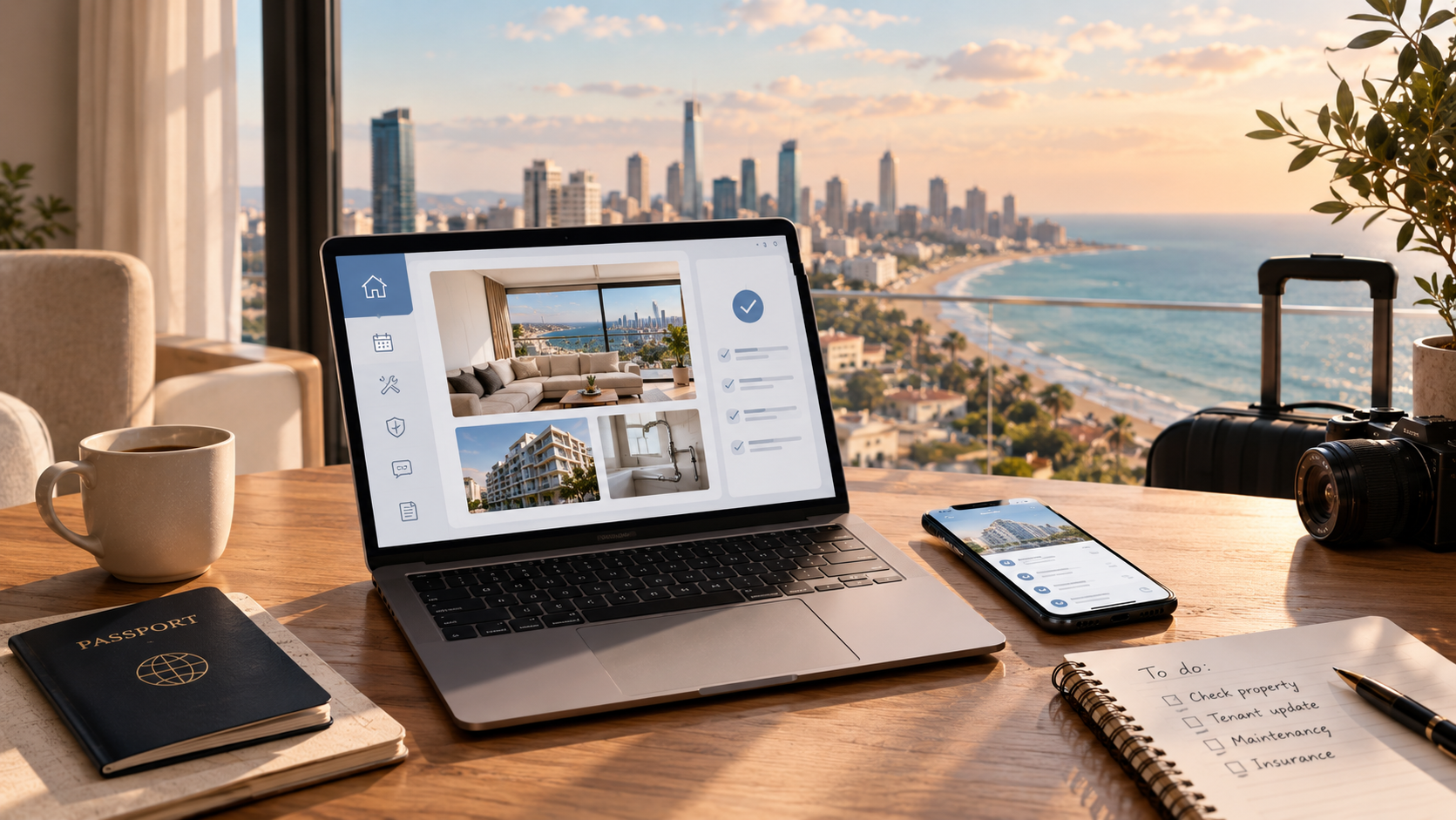
The question almost every property owner living abroad eventually asks themselves is not “what is my property worth,” but something far more basic: what happens if something goes wrong while the owner is not there? A leaking pipe, a tenant who stops paying, storm damage, or simply a period when it is hard to reach Israel – all of these become far more significant when there is no simple way to fly over and check things in person.
This is not a theoretical question. It comes up again and again for owners living in the US, Canada, the UK, or Australia who consider Israel home – sometimes literally, sometimes as an investment they plan to use in the future. The right answer to this question is not “the owner will fly over if something happens,” but a system that keeps functioning even when the owner is not there.
| Key Points Managing a property remotely during a period when reaching Israel is difficult requires preparation in advance, not improvisation after the fact: Local presence – a team that can physically reach the property within hours, not days Documentation set up in advance – an active insurance policy, a building contact, accessible keys A clear communication channel with regular updates, not just when something happens A distinction between what needs immediate attention and what can wait – so the owner is not flooded with every detail Bottom line: Genuine peace of mind is not built at the moment of crisis – it is built well before, through a management structure that is already in place and functioning. |
The Challenge: Owning Property in Israel From the Other Side of the World
The time difference between Tel Aviv and New York is seven hours. Between Tel Aviv and Sydney, nearly half a day. Even in calm periods, a time gap like that turns every small issue into a complicated affair – who answers the phone at an hour convenient for the owner but not for the supplier in Israel, and who confirms the repair was actually completed rather than just “promised.”
During periods when flying itself becomes difficult – whether due to a security situation, health restrictions, or simply a busy personal schedule – the option of flying over on short notice to check in person disappears. That is exactly the moment that reveals whether a property has a professional party managing it, or whether it has been relying on the owner’s personal presence the whole time.
What Can Go Wrong Without Local Presence
The list of things that can happen to a vacant or rented property while the owner is away is not short: water damage discovered too late, an air conditioning system failing in the middle of a heatwave, a tenant who stops paying with no clear next step, or simply routine maintenance that gets neglected because no one remembers to check it. In a holiday home that sits empty most of the year, even simple things like periodic presence checks become critical – a topic covered in the guide to holiday home management in Israel.
The real problem is not that these things happen – they happen to every property owner sooner or later – it is how long it takes to discover them and how quickly there is a response. A gap of a few days between a water leak and a repair can turn a minor issue into significant damage.
What Professional Real-Time Management Includes
Professional management that keeps working even in difficult periods rests on a few simple foundations: periodic visits to the property even when there is no tenant, a tradesperson available for urgent issues, and organised documentation of the property’s condition over time – so a problem can be compared and identified before it grows. The Agency’s holiday home management service, for example, includes biweekly inspections and ongoing budget oversight, precisely so the owner does not have to discover a problem on their own.
For rented properties – whether long-term or short-term – professional management also includes upfront tenant screening, which reduces in advance the risk of the most problematic scenario: a tenant who stops paying and becomes unreachable.

Communication and Transparency: What to Expect From a Good Company
A good sign of proper management is not just a fast response when something happens, but ongoing updates even when nothing happens – a monthly report, confirmation that a scheduled visit took place, photographic documentation of the property’s condition. An owner who only hears from their manager when there is a problem is at a disadvantage: they do not know whether the silence means everything is fine, or simply that no one is checking. This is exactly the approach The Agency TLV teams work by – regular updates to owners, even during quiet periods, not only when something needs attention.
Anyone who wants to understand the full scope of what professional management includes, not just the emergency components, can read the complete guide to property management for overseas owners.
Getting Ready Before Anything Happens
- Confirm your property insurance policy is active, and know exactly what it covers
- Make sure you have at least one local contact with physical access to the property – not just a phone number
- Keep a digital copy of property documents, including the lease, land registry extract, and insurance details, accessible from anywhere
- Define in advance who is authorized to approve urgent expenses up to a set amount, without waiting for phone approval from the owner
- Set a fixed update schedule in advance, so you do not have to ask what is happening yourself
Why Owners Choose Ongoing Local Support
Owners who have already been through a period when a small issue turned into a bigger problem, simply because no one was there to handle it in time, generally do not go back to self-management. They look for a local team that knows the property over time – not just a party that shows up once, when called.

Questions Worth Asking Before Choosing a Management Company
Not everyone who presents themselves as a “property manager” is genuinely prepared to handle a challenging period. Before signing with a management company, it is worth asking a few focused questions: how long does it actually take the team to reach the property in an emergency? Who steps in if the primary point of contact is unavailable? Is there a written emergency procedure, or is everything improvised in real time? How many properties does the same team currently manage, and how does that affect their availability?
The answers to these questions reveal far more than a sales pitch. A management company that answers confidently and in detail, with examples from real situations, is generally genuinely prepared to handle the unexpected – while vague answers are a warning sign.
Getting Insurance Right: More Than Just “Having a Policy”
One of the most common mistakes is assuming that having some insurance policy is enough. In practice, there is a meaningful difference between a basic structure insurance policy and one that also covers contents, loss of rental income during repairs, and third-party liability – particularly relevant for a rented property. An owner living abroad needs to verify not just that the policy is active, but that it actually matches how the property is used in practice: whether it is rented short-term, long-term, or sits empty as a holiday home – each of these situations has different implications for the coverage needed.
It is also worth checking in advance who is responsible for filing a claim in the event of damage – whether that is something the owner needs to do remotely themselves, or whether the management company handles it as part of ongoing service. That difference can determine whether an insurance claim is resolved within days or drags on for weeks.
Frequently Asked Questions
Q: What happens if a tenant stops paying and I cannot get to Israel?
A: A professional management company handles the process with the tenant on the owner’s behalf, including documentation, legal action if needed, and ongoing communication – so the owner does not need to be physically present in Israel for the process to move forward.
Q: How long does it take to discover damage to a vacant property without periodic visits?
A: Without regular visits, damage such as a water leak may only be discovered at the next visit – sometimes months after it started. Periodic inspections are the only practical way to shorten that gap.
Q: Do I need power of attorney for someone to act on my behalf in Israel?
A: In many cases, yes – particularly for actions involving authorities or banks. It is best to check this in advance with a lawyer rather than waiting until an urgent need arises.
Q: What is the difference between a basic structure insurance policy and one suited to a remote owner?
A: A basic policy usually covers only the structure itself. An owner living abroad should check that the policy also includes coverage for contents, loss of rental income during repairs, and third-party liability – depending on how the property is actually used (rented, holiday home, and so on).
About The Agency TLV
The Agency TLV provides professional, reliable property management in Israel for holiday homes, long-term rentals, and short-term rentals, with particular focus on owners living abroad. The team handles maintenance, tenant screening, and every ongoing detail to preserve peace of mind even when the owner is not in the country. For more information, contact us, or explore the full scope of services.