

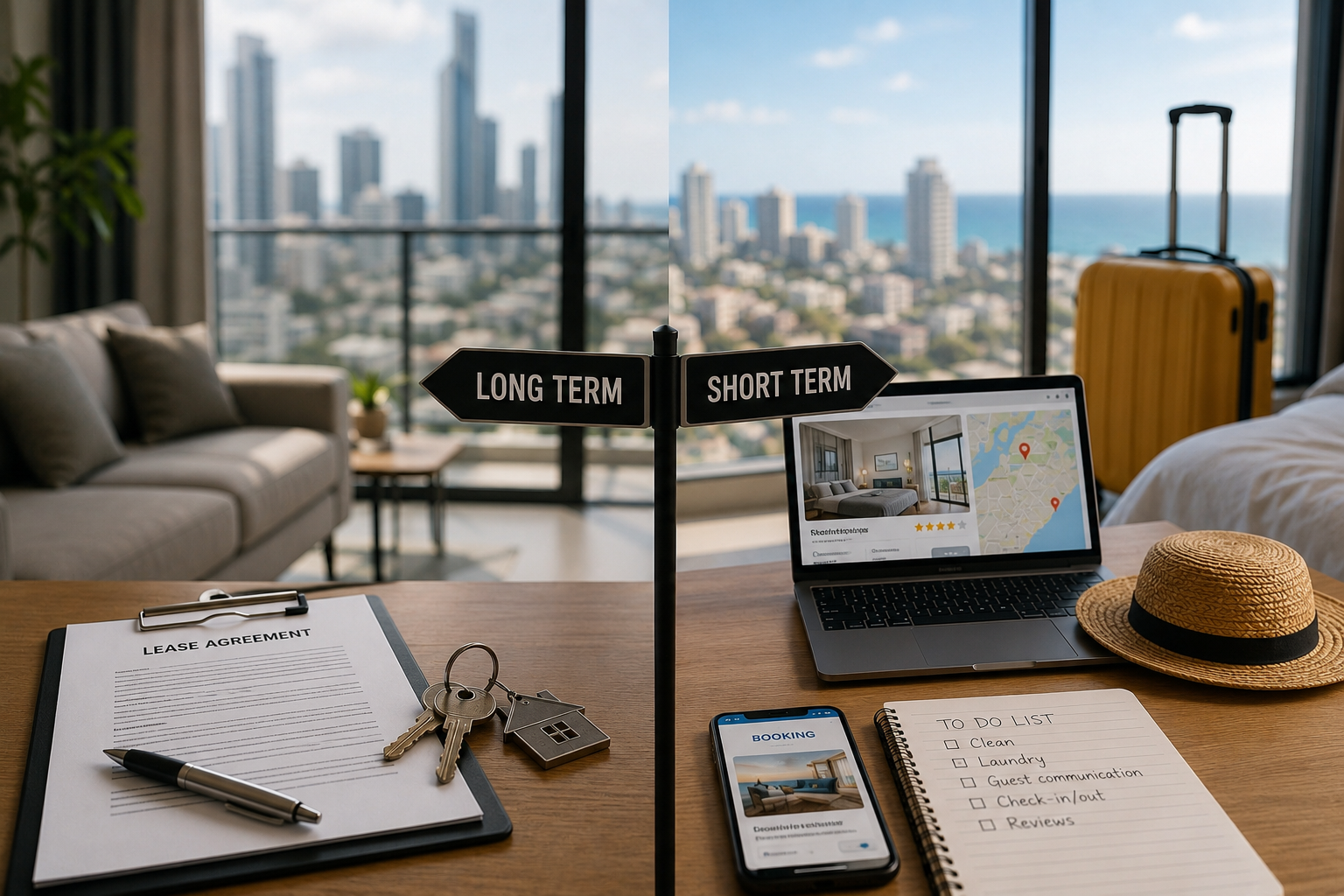
Selecting between short-term hospitality stays and long-term residential leases in Israel requires balancing expected gross revenue against local tax structures, municipal licensing, and operational overhead. While short-term rentals offer higher revenue potential and calendar flexibility, long-term leasing provides predictable income with minimal management intensity and lower tax friction.
Key Points
- Yield vs. Predictability: Short-term rentals offer higher gross yields (6%–12%+) in prime areas, while long-term leases deliver stable 3.5%–5.5% returns.
- Tax Classification Impact: Long-term rentals qualify for a simple 10% flat tax, whereas short-term income is taxed as business income and triggers 18% VAT above NIS 120,000/year.
- Regulatory Compliance: Tel Aviv short-term rentals require municipal business licensing and HOA approval, whereas long-term leases face no municipal licensing requirements.
- Operational Expense Stack: Short-term management, turnover cleaning, and platform fees consume 35%–50% of gross revenue, significantly narrowing the net yield gap.
- Hybrid Strategy Model: Switching to short-term rentals during peak seasons (April–October) and mid-term corporate stays during winter optimizes occupancy and income.
- The Bottom Line: Choose long-term leasing for passive stability and short-term hospitality for active yield optimization supported by local professional management.
Every property owner in Israel eventually faces the same fork in the road: do you sign a 12-month lease with a reliable tenant and collect a predictable monthly rent, or do you open the apartment to nightly and weekly guests, manage occupancy dynamically, and chase the higher yields that the short-term market can deliver?
Both paths lead to rental income. But they lead there through entirely different terrain – different tax treatment, different regulatory obligations, different management demands, and different risk profiles. Getting the strategy wrong for your specific property and your specific situation as an owner can cost more than the yield difference you were hoping to capture. This guide maps both strategies side by side so you can make the decision with clear eyes.
Understanding the Two Models
Before comparing them, it is worth being precise about what each model actually means in the Israeli context, because local law defines both more specifically than many owners expect.
Long-Term Rental
In Israel, a long-term residential rental is typically a lease of 12 months or more, governed by the Rental and Loan Law and Israeli contract law. The tenant signs a formal Hebrew-language lease, provides a financial guarantee – either a bank guarantee or a personal guarantor – pays a deposit, and assumes responsibility for municipal tax (Arnona) during the tenancy. The owner receives a fixed monthly shekel-denominated payment, and the property is largely self-managing on a day-to-day basis. Maintenance requests arise but do not require daily attention. The owner’s primary management touchpoints are tenant sourcing, lease renewal, and periodic inspections.
Short-Term Rental
Short-term rental is legally defined in Israel as any rental of less than 30 days per stay. Operationally, this covers everything from two-night leisure stays booked through online platforms to multi-week corporate lettings. The property is furnished and equipped to a hospitality standard – linens, kitchen equipment, cleaning supplies, and ideally a welcome guide. Pricing changes nightly based on demand. Guests turn over frequently. And the owner – or their management company – handles pre-arrival coordination, key handover, cleaning between stays, maintenance response during occupancy, review management, and platform administration across multiple listing channels simultaneously.
The Yield Comparison: What the Numbers Actually Look Like
The gross yield gap between short-term and long-term rental in Israel is real, but it is not uniform, and it is not guaranteed. It depends heavily on location, property specification, management quality, and the specific mix of guest segments the property attracts.

Long-Term Rental Yields
For a well-located Tel Aviv apartment, gross long-term rental yields currently run between 3.5% and 5.5% annually. A two-bedroom apartment in the Old North or Rothschild corridor renting for 8,000 to 12,000 shekels per month generates predictable annual income. The yield is lower as a percentage than short-term rental, but the income arrives monthly, requires minimal management attention, and carries no seasonal risk. For a non-resident owner who cannot respond to daily operational demands from abroad, this predictability has real financial value that a headline yield comparison does not capture.
Short-Term Rental Yields
A professionally managed two-bedroom apartment in a prime Tel Aviv location – central beachfront, Neve Tzedek, or Rothschild Boulevard – can generate gross annual revenue of 140,000 to 200,000 shekels, depending on specification, occupancy, and pricing strategy. At a property value of 3 to 4 million shekels, that translates to a gross yield of 4% to 6.5% before management costs. The best-performing properties, in the strongest locations, managed with dynamic pricing and maintained to a high hospitality standard, reach 8% to 12% gross at the top of the range. These are not typical figures – they represent the top quartile of the professionally managed market.
Net Yield: Where the Real Comparison Lives
Gross yield comparisons flatter short-term rental. The net yield calculation – after management fees, platform commissions, cleaning costs, linen replacement, maintenance, municipal licensing, and the tax liability difference between the two classifications – narrows the gap considerably. A professionally managed short-term rental in Tel Aviv typically incurs total operating costs of 35% to 50% of gross revenue. After those costs, the net yield advantage over long-term rental is real but more modest than the headline numbers suggest. For many non-resident owners, the net calculation tips toward long-term rental once the full cost stack is modelled.
Advantages of Short-Term Rental
Higher Gross Revenue Potential
When conditions align – strong location, high specification, professional management, and a well-timed seasonal strategy – short-term rental delivers meaningfully higher gross income than a comparable long-term lease. In peak periods, nightly rates for a well-presented sea-view two-bedroom in Tel Aviv range from 750 to 1,100 shekels. A full week at those rates exceeds what the same property earns in a month of long-term rent. The revenue ceiling is genuinely higher.
Flexibility and Personal Use
A short-term rental calendar can be blocked for personal use at any time. Owners who want to spend time in their Tel Aviv apartment during Jewish holidays, summer, or specific periods can simply close those dates to guests. A long-term lease eliminates this flexibility entirely for its full duration – typically 12 months, sometimes longer with renewal options. For diaspora owners who visit Israel regularly, this flexibility has real lifestyle value that does not appear in a yield comparison.
Lower Single-Tenant Concentration Risk
A long-term tenancy concentrates all rental risk in one household. If the tenant loses their job, separates, or simply stops cooperating, the arrears process under Israeli law is slow and the owner’s income stops while the legal process runs. Short-term rental distributes that risk across hundreds of independent guest stays per year. No single non-paying guest can derail the property’s income stream the way a non-paying long-term tenant can.
Ability to Reprice as Market Changes
A 12-month lease locks in the rent for its full term. If the market moves up – as Tel Aviv rents have consistently done – the owner cannot reprice until renewal. Short-term rental allows constant repricing in response to market conditions, local events, and competitor availability. In a rising market, this responsiveness captures value that fixed-term leases forfeit.
Advantages of Long-Term Rental
Predictable, Stable Income
The most undervalued advantage of long-term rental is that the income arrives on the first of every month without operational effort. There is no occupancy to manage, no pricing to update, no guest who checks in at midnight, no emergency cleaning required between stays. For an owner with a full-time job, a family, or a life in a different time zone, this operational simplicity is worth a meaningful yield discount.
Significantly Lower Tax Complexity
Long-term residential rental income in Israel qualifies for the 10% flat-rate tax track, which is one of the most administratively straightforward tax positions available to non-resident property owners anywhere. A fixed 10% on gross rent, no deductions required, no VAT registration, no business income filing. Short-term rental income is classified as business income, is taxed at the marginal rate on net income, and – above approximately 120,000 shekels per year – triggers mandatory VAT registration at 18%. The compliance cost and administrative burden of the short-term tax position are substantially higher. For owners without Israeli accounting support already in place, this difference is not trivial.
No Regulatory Licensing Required
Long-term residential rental in Israel requires no municipal business license. Short-term rental in Tel Aviv requires a formal business license application to the municipality, along with confirmation that the building’s internal regulations permit the activity. Some buildings prohibit short-term rental entirely. Discovering this after purchase – or after renovation to a hospitality standard – is a painful and expensive outcome. Long-term rental carries none of this regulatory overhead.
Lower Wear and Maintenance Frequency
A long-term tenant treats the property as a home and is contractually responsible for fair wear and tear. A short-term rental property receives the equivalent of hotel-level use – frequent guest turnover, intensive use of appliances, linens cycling weekly, and a higher probability of accidental damage from guests unfamiliar with the property. The maintenance frequency and consumables cost of a short-term rental operation is materially higher than a long-term tenancy, and this ongoing cost is often underestimated in initial yield projections.
Better Suited to Non-Resident Owners Operating Without Local Management
If you are a non-resident owner who does not have a professional property manager in place, long-term rental is the only operationally realistic strategy. Self-managing a short-term rental from a different country and time zone – handling guest enquiries, coordinating cleaners between stays, responding to maintenance issues on the same day, managing platform calendars, and updating nightly pricing – is not a workload that can be sustained remotely without dedicated professional support.
The Full Comparison: Side by Side
The table below maps both strategies across every dimension that matters to a property owner in Israel. Use it as a working reference, not a verdict – the right strategy depends on your specific property, your location, your tax position, and your capacity to manage or fund management.
| Category | Short-Term Rental (nightly / weekly) | Long-Term Rental (12-month lease) |
| Gross annual yield | 6% – 12%+ (prime, professionally managed) | 3.5% – 5.5% |
| Income predictability | Variable – season and occupancy dependent | Fixed monthly income |
| Israeli tax classification | Business income (Hachnasa Me’esek) | Passive rental income |
| Flat 10% tax available | No | Yes |
| VAT registration required | Above ~NIS 120,000/year | Not required |
| Municipal business license | Required in Tel Aviv | Not required |
| Management intensity | High – daily pricing, guest comms, cleaning | Low – monthly oversight |
| Tenant/guest damage risk | Low per stay, high cumulative wear | Medium – covered by deposit |
| Vacancy risk | Seasonal (Nov – Feb softer) | Minimal during lease term |
| Best property types | Sea-view, well-furnished, central locations | Any residential unit |
| Best for | Active investors, professionally managed | Passive investors, overseas owners |
| Seasonal flexibility | Can switch strategy by season | Locked in for lease duration |
The Hybrid Strategy: Getting the Best of Both
The binary choice between short-term and long-term rental is less fixed than it appears. An increasing number of experienced owners in Tel Aviv operate a hybrid model that optimises income across the calendar year by switching between strategies based on demand patterns.
The core of the hybrid approach is straightforward: the property operates as a short-term rental from April through October, when Tel Aviv’s leisure and conference tourism is strongest, nightly rates are highest, and occupancy is easiest to sustain. From November through February – the period when nightly short-term demand softens and rates compress – the property transitions to a furnished mid-term letting, typically one to three months, targeting corporate relocatees, tech professionals on medium-term assignments, or families between permanent housing. This mid-term segment accepts monthly rates that beat the equivalent daily short-term rate in the low season while requiring far less operational management than nightly lettings.
Structuring this kind of dual-season strategy requires an understanding of both the market conditions and the tax implications of mixing rental classifications within a single property year. The Agency TLV’s editorial resource on 5 Israeli Real Estate Investment Strategies for 2025 (Expert Rental Property Tips) provides a grounded framework for evaluating these decisions in the current market environment.
What Every Owner Needs to Know Before Choosing
Your Property’s Location Determines Its Short-Term Potential
Not every Tel Aviv apartment is a viable short-term rental. Properties in the central beachfront corridor, Neve Tzedek, Rothschild Boulevard, and the immediate surroundings of Dizengoff Square have strong short-term demand from multiple guest segments. Properties in residential neighbourhoods further from the beach and the cultural core – Ramat Aviv, Kiryat HaMelacha, outer Florentine – have a narrower short-term guest pool and will struggle to sustain the occupancy levels that make the model financially superior to long-term rental. Honest location assessment before committing to a short-term strategy avoids the expensive mistake of furnishing and licensing an apartment for a use case the local demand does not support.

Professional Management Is Non-Negotiable for Short-Term
The yield figures associated with short-term rental are management-dependent. An owner who lists their apartment on a single platform at a static price, handles guest communication personally, and arranges cleaning through a single contact will not achieve the revenue levels that a professionally managed property in the same building achieves. The gap between self-managed and professionally managed short-term rental performance in Tel Aviv is consistently 30% to 50% on annual revenue – a difference that, in most cases, more than covers the management fee. If you cannot commit to professional management, long-term rental will likely deliver a better net outcome.
Check Your Building Rules Before Anything Else
Before spending a single shekel on furnishing, licensing, or marketing a short-term rental, confirm in writing that your building’s internal regulations (takanon habayit) permit the activity. Building committees in Tel Aviv have legal authority to prohibit short-term rental in their building, and many have exercised it – particularly in buildings where a minority of short-term rental units has created noise, security, or community concerns for long-term residents. A verbal assurance from a neighbour or even a committee member is not sufficient. Request a formal written statement of the committee’s position before committing to the strategy.
Understand Your Tax Position Before You Earn Your First Shekel
The decision to operate a short-term rental is effectively a decision to become a business income taxpayer in Israel – with all the filing obligations, VAT exposure above the 120,000 shekel threshold, and ongoing accounting costs that entails. This is not a reason to avoid short-term rental if the numbers work, but it is a reason to model the full tax cost before you earn your first booking rather than after. An Israeli accountant who works with non-resident rental owners can prepare a net income projection for both strategies specific to your property value, expected revenue, and home country tax treaty position.
Frequently Asked Questions (FAQ)
The questions property owners ask most when weighing up rental strategy in Israel.
Q: At what point does short-term rental genuinely outperform long-term rental in Tel Aviv, net of all costs?
A: Based on current market data, short-term rental in a prime Tel Aviv location begins to outperform long-term rental on a net basis when the property achieves consistent annual occupancy above 55%, is managed by a professional operator using dynamic pricing, and the owner’s marginal income tax rate in Israel on the short-term classification does not significantly exceed the 10% flat rate available on long-term income. For a two-bedroom apartment in the central beachfront corridor or Neve Tzedek, a professionally managed short-term rental generating 160,000 to 190,000 shekels gross per year will typically outperform a long-term lease on a net basis even after management costs, VAT (where applicable), and higher maintenance frequency. For properties in secondary locations generating 90,000 to 120,000 shekels gross per year, the net advantage is much narrower and sometimes negative once the full cost stack is applied. The break-even point is property-specific and should be modelled before the strategy is chosen, not after.
Q: Can I switch from short-term to long-term rental if the short-term strategy is not working?
A: Yes – and this flexibility is one of the genuine advantages of property ownership over other investment classes. However, switching back to long-term rental after furnishing and licensing a property for short-term use involves some practical considerations. The property will be furnished to a hospitality standard, which long-term tenants may or may not want to maintain. The furniture and equipment represent a sunk cost that is partially recoverable through depreciation but not through the tenancy itself. The municipal business license will simply expire or can be allowed to lapse. The VAT registration will need to be deregistered with the Israeli Tax Authority once activity ceases. None of these is a major obstacle, but they should be factored into the initial decision. Many owners who make the switch report that the furnished standard of the property actually enables them to achieve a rent premium above unfurnished equivalents when transitioning to long-term lettings.
Q: If I use a property management company for short-term rental, what should their fee cover and what will I pay?
A: Professional short-term rental management fees in Israel typically run between 15% and 25% of gross rental revenue – a significantly higher percentage than long-term management fees, which reflect the greater operational intensity of the model. At the top end, this management fee should cover dynamic nightly pricing, listing management across multiple platforms, all guest communication from enquiry through checkout, coordination of cleaning between every stay, linen provision and laundering, basic maintenance coordination up to a defined threshold, periodic property inspections, and a monthly revenue and performance report to the owner. Below the management fee, owners should expect to pay directly for consumables and linen replacement, maintenance costs above the threshold, platform commissions (typically 3% to 5% of revenue charged by the platforms themselves), municipal licensing costs, and any renovation or equipment upgrades. Before signing a management agreement, request a complete written fee schedule that distinguishes between what is included in the percentage fee and what is charged separately. The total cost picture across both the management fee and the pass-through costs should be modelled against your expected gross revenue before committing.
About The Agency TLV
The Agency TLV provides professional short-term rental management in Israel alongside long-term rental management for owners across Tel Aviv’s most sought-after neighbourhoods. Whether you are deciding between strategies for the first time or looking to optimise a property you already own, the team can model the net yield position for your specific situation and manage the full operation from licensing through to monthly reporting.