


Evaluating self-management against professional property management requires weighing visible fee savings against non-monetary and operational costs. For overseas owners, managing a property remotely involves navigating time-zone gaps, language barriers, complex Israeli tenancy laws, and significant potential lost revenue—making professional oversight a strategic investment in asset protection.
Key Points
- Time-Value Equation: Eliminates remote operational demands, time-zone delays, and round-the-clock emergency availability for overseas owners.
- Revenue Optimization: Captures dynamic short-term pricing and multi-platform distribution, narrowing or overcoming management fee costs.
- Fixed Cost Conversion: Replaces unpredictable risks—such as extended vacancies, bad debts, or delayed maintenance—with a transparent fee structure.
- Legal Risk Mitigation: Enforces legally compliant Hebrew leases, screens tenants, and ensures proper financial guarantees to prevent costly disputes.
- Seamless Transition: Integrates ongoing tenancies and active management without operational downtime or tenant disruption.
- The Bottom Line: Professional management converts cross-border risks and owner stress into a predictable, time-saving investment model.
What “Managing a Property Yourself” Really Means Remotely
Self-managing a property in the same city where you live is one thing. Self-managing a property in Israel while living in New York, London, or Toronto is a fundamentally different matter. Every phone call with a prospective tenant, every coordination with a maintenance provider, every piece of bureaucracy with local authorities – all of it happens across a time gap, and often in a language that is not your native one.
That does not mean it is impossible. Thousands of owners manage properties this way successfully. The question is what it costs them – not just in money, but in the time they invest, the opportunities they miss, and the risk they take on without realizing it.
The Hidden Cost: Your Time
The trouble with “self-management” is that its cost never appears on any invoice. An hour spent replying to a prospective tenant, two hours coordinating a tradesperson and confirming they actually showed up, an entire evening spent on bureaucracy with the authorities – all of that is time that does not go toward work, family, or simply rest. Add that up over a full year, and it amounts to far more hours than most owners estimate going in.
There is also a harder-to-quantify time cost: the cumulative stress of knowing you are “on call” at all times, every hour, because there is no one else to handle a problem but you. That is a real cost that does not show up on a profit-and-loss statement, but it is genuine nonetheless.
And What About the Income Left on the Table
In short-term rental, where accurate pricing and continuous availability are critical to income, the gap between self-management and professional management is not marginal. As detailed in the article on short-term versus long-term rental in Israel, the performance gap between a self-managed and a professionally managed property in Tel Aviv consistently runs 30% to 50% of annual revenue – a gap that, in most cases, is well beyond the cost of the management fee itself.
The reason for the gap is not abstractly “more professionalism,” but very concrete factors: pricing that updates daily based on demand, presence across multiple booking platforms at once, fast response times to inquiries that prevent lost bookings, and review management that directly affects the property’s ranking.
What Professional Management Actually Costs
Management fees vary depending on the rental model – long-term management typically costs a lower percentage of rental income than short-term management, which demands far greater operational involvement. A full breakdown of the fee structure, including what is included in the management fee and what is billed separately, appears in the guide to property management fees and pricing in Israel. That transparency matters – before comparing cost against self-management, you need to know exactly what the payment covers. At The Agency TLV, for instance, the management fee always comes with a written breakdown of exactly what it includes, so owners know precisely what they are paying for and do not discover additional charges along the way.
A Side-by-Side Comparison
| Parameter | Self-Managed | Professionally Managed |
| Availability for issues | Entirely dependent on the owner, any hour | Local team available on an ongoing basis |
| Pricing and occupancy (short-term) | Usually static, rarely updated | Dynamic, updated based on demand |
| Cost | No direct payment, high time cost | Fixed percentage of rental income |
| Risk from a problem tenant | Falls entirely on the owner | Handled by an experienced professional party |
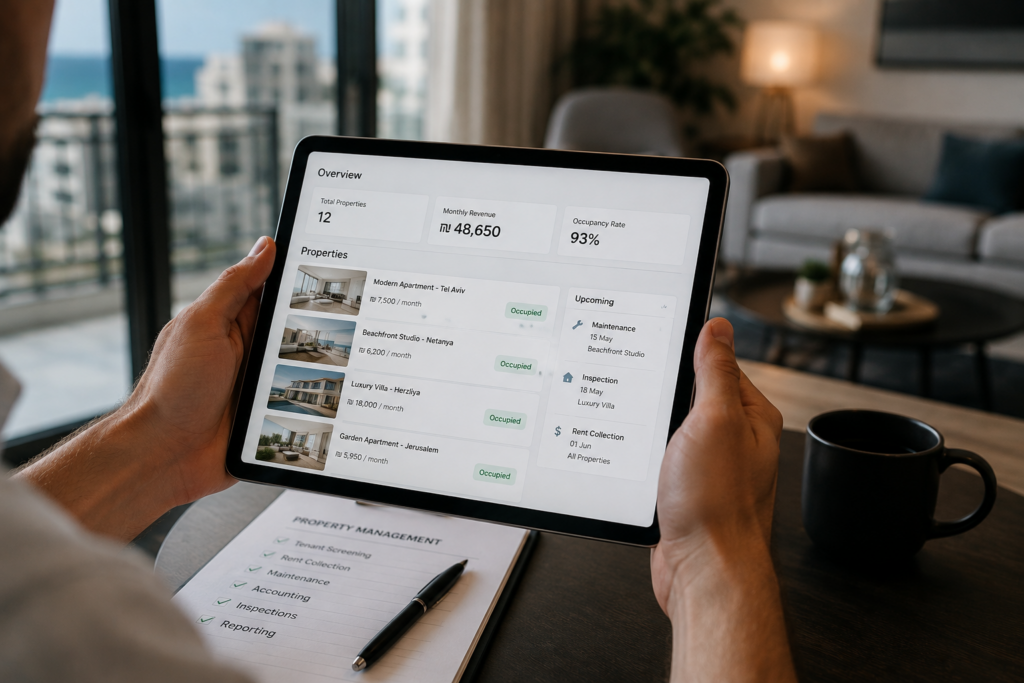
| Transparency and documentation | Depends entirely on the owner’s own initiative | Regular, ongoing reports |
When Self-Management Still Makes Sense
Self-management is a reasonable option in certain cases: an owner who lives in Israel, holds a single property rented long-term to a stable tenant, and has spare time to handle day-to-day matters. In that situation, the time cost is relatively low and the risk is limited, so the management fee does not necessarily pay for itself.
When Professional Management Becomes Nearly Essential
As the picture becomes more complex – an owner living abroad, more than one property, a short-term rental model requiring daily involvement, or a holiday home sitting empty most of the year – the time cost and risk of self-management rise well beyond the cost of the management fee. For owners in that position, the question is no longer “should I,” but “with whom” – a topic covered at length in the guide to property management in Israel for overseas owners.
The Legal Risk That Is Easy to Overlook in Self-Management
Beyond time and income, there is also a legal risk that self-managing owners tend to underestimate. An imprecise lease agreement, missing the right guarantee or guarantor requirement, or failing to comply with Israeli rental law – any of these can turn a simple dispute with a tenant into a long, expensive legal process. An owner living abroad who does not know Israeli law in depth is exposed to exactly this kind of mistake at the most critical points – the start of the lease and its end.
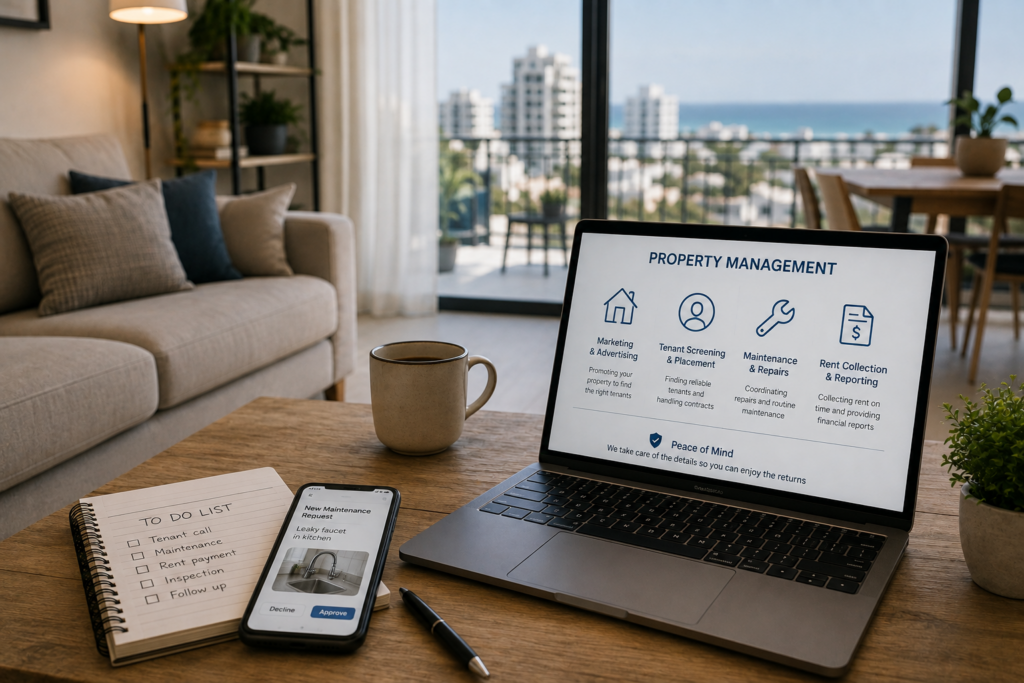
Professional management does not eliminate legal risk entirely, but it reduces it significantly: pre-vetted standard contracts, a tenant screening process that includes background checks and appropriate guarantees, and organized support in the event of a dispute. For a remote owner, that is often worth more than the management fee itself.
What the Transition to Professional Management Actually Looks Like
Owners weighing whether to continue self-managing or switch to professional management often ask what the process itself looks like. It typically starts with a property survey – a physical visit where the property’s condition is documented, systems are checked, and, if there is an existing tenant, the current lease is reviewed and confirmed to be valid and up to date. Communication channels, reporting frequency, and who is authorized to approve what are then defined – so the owner knows exactly what to expect from day one.
In most cases, the transition itself does not require pausing operations or removing an existing tenant – the management company simply steps into the role and continues ongoing management, including handling anything already in progress. That is how it works at The Agency TLV as well – an initial consultation, a property survey, and then a smooth transition with no gap in ongoing management of the property.
Frequently Asked Questions
Q: Is self-management always cheaper?
A: In terms of direct payment, yes. But once you factor in the value of the time invested and the additional income professional management typically generates – especially in short-term rental – the real economic gap narrows considerably, and sometimes tips in favour of professional management.
Q: How much time does self-managing a property in Israel from abroad typically take?
A: It varies by rental model and how often issues arise, but owners who share their experience typically describe a few hours a week during quiet periods, with significant spikes around repairs or tenant turnover.
Q: Can I switch from self-management to professional management mid-lease?
A: Yes, this is a common and relatively simple transition in practice. A professional management company can take over the property and the existing tenant and continue management without disruption.
Q: What is the main legal risk in self-managing remotely?
A: An imprecise lease agreement or missing the right guarantee requirements can turn a simple tenant dispute into a lengthy legal process. An owner who does not know Israeli law in depth is exposed to exactly this kind of mistake at the most critical points – the start of the lease and its end.
About The Agency TLV
The Agency TLV manages properties in Israel for both local and overseas owners, with transparent management fees and ongoing reports that show exactly what you get in return. To get a cost estimate tailored to your property, contact us, or first review the full scope of services.